Every ag employer has the same moment, usually right before the season ramps up: a supervisor sees a familiar name and says, “Oh...not that person.”
Sometimes it’s justified. Sometimes it’s fuzzy. Sometimes it’s just tribal knowledge: a mental list, a spreadsheet, a note in someone’s phone, or “ask Carlos, he remembers.”
The problem is that an ad hoc “do-not-rehire” list creates more problems than it solves, and it’s almost impossible to defend when an angry employee or their lawyer asks: Why?
Ad hoc = 💸💸💸
When you don’t have a system, there are a handful of things I’ve seen happen:
- Decisions become inconsistent.
One supervisor “blacklists” a worker for repeated tardiness; another supervisor overlooks the same behavior because of fill-in-the-blank (nepotism, production quotas, just doesn’t care). Inconsistent enforcement is where allegations (and resentment) thrive. And it can even be worse if that employee slips through and gets rehired again because they went to another location that doesn’t know they're a Do Not Rehire (DNR). - Your “why” disappears over time.
Even if there was a solid reason originally, memories fade, managers change, and seasons blur together. When a former employee comes back next year, or when a complaint lands on your desk, you’re left with, “We just don’t rehire them.” - The risk concentrates in rehiring decisions.
Refusing to rehire can become a flashpoint for claims of unfairness, retaliation, or discrimination, especially if the employee previously complained about wages, housing, safety, harassment, or working conditions. If you can’t point to a documented, job-related history, you might be forced to defend a decision you can’t explain. - It wastes time and creates operational drag.
Instead of a clean “yes/no” hiring decision, you get back-and-forth: texts to old supervisors, digging through paper, searching inboxes, debating what happened. That’s lost time during the busiest weeks of the year. What should take seconds ends up taking minutes. It also puts your frontline HR assistants in a position even more uncomfortable than saying no: angry worker, liability concern, and uncertainty about making the wrong decision.
A better philosophy: rehire decisions should be based on documented events.
Keep it simple:
Enforce policy + evidence by making rehire decisions based on documented events, such as terminations and discipline, not on ad hoc lists.
In other words, a rehire decision isn’t a separate, mysterious “status” someone puts in an employee’s file after the fact. It’s the natural result of:
- How the employment ended, and/or
- What was documented during employment (discipline and incident history)
I think this philosophy has two benefits at the same time:
- It creates fairness and consistency for employees (especially while they are on the job). I’ve seen this happen where a problematic employee’s behavior wasn’t documented, and they weren’t fired because “the season is ending soon anyway.”
- It gives farms a defensible, repeatable process that holds up under scrutiny.
The building blocks: discipline tracking + termination tracking
To make this work, you need two systems that talk to each other.
1. Discipline tracking
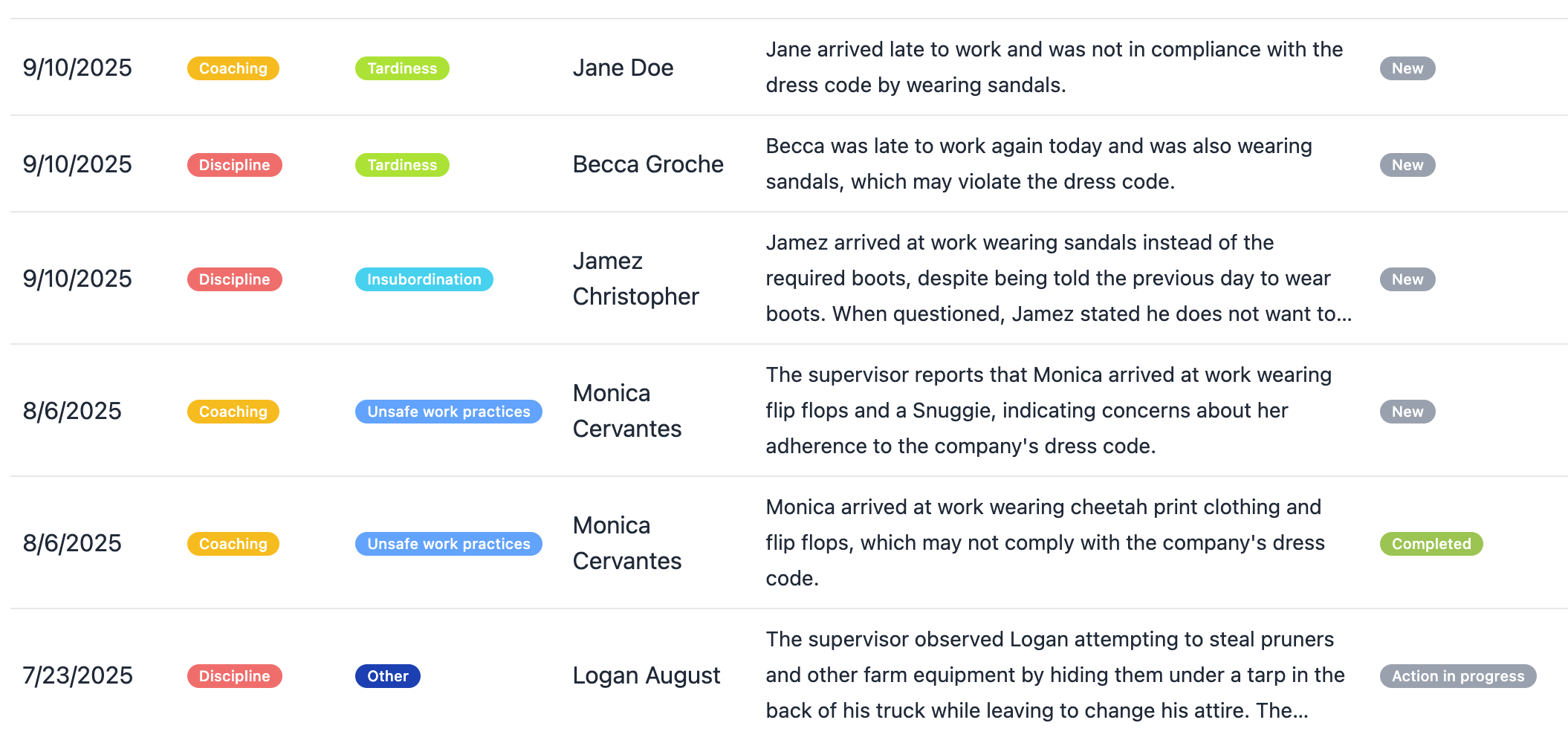
Discipline tracking doesn’t need to be complicated. It just needs to be consistent. Ask yourself, how consistent is your farm’s employee discipline process?
At a minimum, you need to know:
- What happened (category)
- When it happened (date and time)
- Who documented it (mayordomo/supervisor/HR admin)
- What action was taken (coaching, warning, final warning, suspension)
When discipline is captured in the moment, it prevents the biggest compliance mistake: trying to reconstruct a story later.
That’s the “documented event”; now you need a re-hire policy. I’ve seen our growers adopt simple rules that translate discipline into consequences:
- A “three strikes” approach within a season or time window.
- Certain severe violations are an immediate rejection.
- Repeated patterns (attendance, farm safety noncompliance, quality issues)
This creates predictability: employees know what matters, supervisors know what to document, and HR can apply the same standards across crews. FYI, a good discipline program has benefits that reach far beyond rehire eligibility!
2. Termination tracking
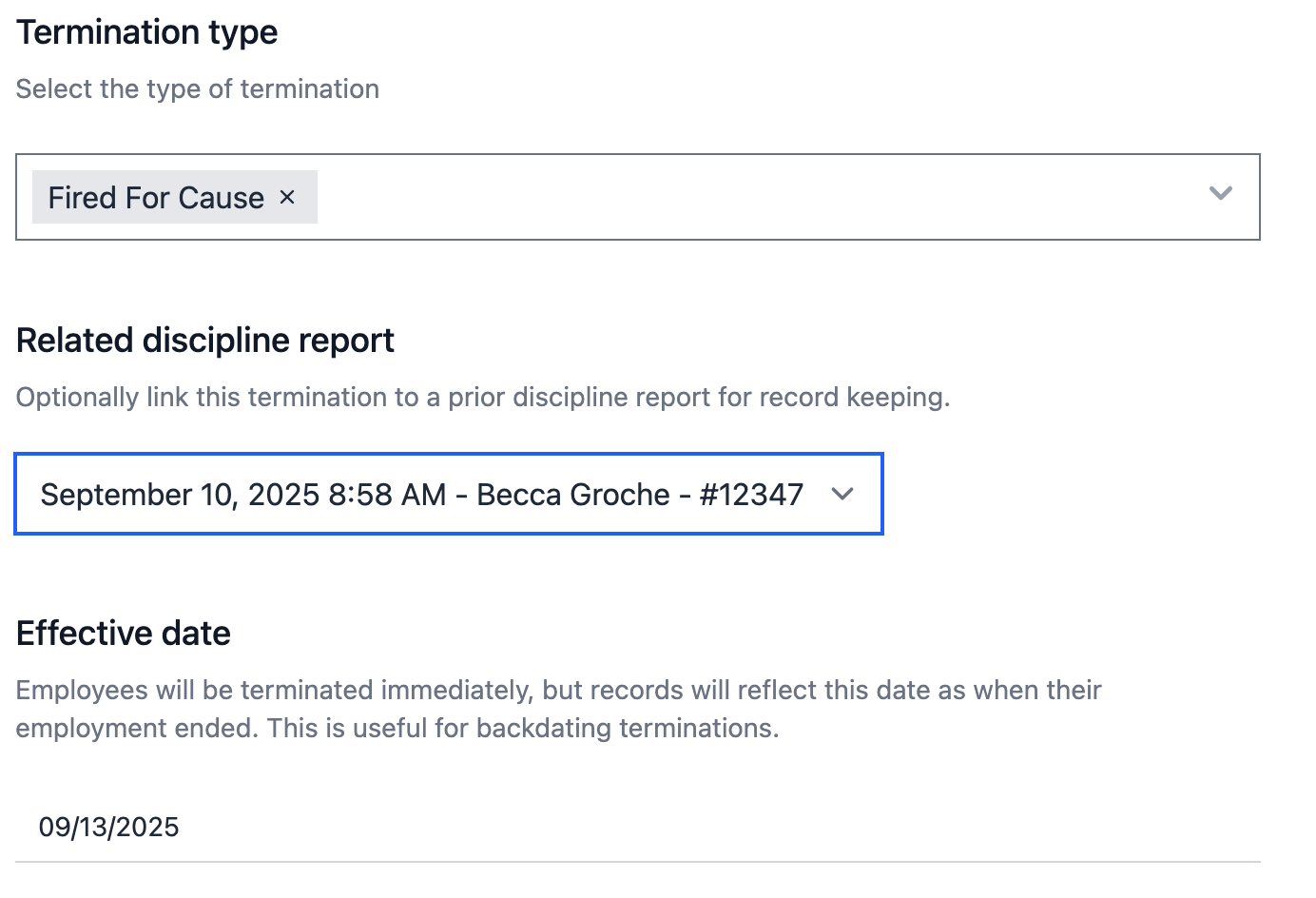
Termination tracking turns the end of employment into structured data, so rehiring isn’t guesswork. Whenever an employment relationship ends (good or bad), it should be documented. But it’s the “bad” ones that are most informative, even when there’s no discipline to track, like an employee who just abandons the job, or never shows up for their first day of work (even though technically they’ve been hired).
These are the building blocks I think are critical to a good termination tracking system:
- A required termination type selected from standardized options (no making up specific reasons for specific situations, that’s as bad as ad-hoc)
- Optional notes (helpful, but not the foundation)
- The ability to define which termination types are eligible for rehire (and to change that policy over time)
This is where many growers already have good instincts. The missing piece is connecting that end-of-season record to what happens when a farmworker shows up at your door next season.
The new hire flow
The biggest leverage point is the one place you must make a decision: onboarding.
A strong system will automatically flag potential employees when:
- The applicant’s prior termination type is ineligible for rehire, or
- The applicant’s documented discipline history triggers the company’s policy (three strikes, specific types, patterns, etc.)
That’s the moment where “ad-hoc knowledge” gets replaced by “policy + evidence.” The system doesn’t say, “don’t hire them because someone remembers.” It says:
- Here’s the prior termination record.
- Here are the documented discipline events.
- Here’s the policy that applies.
- Here’s what needs review or approval. This arms your farm’s frontline HR staff with the information they need to confidently turn away ineligible workers.
How Harvust helps you implement this
Harvust helps ag employers track the two building blocks: discipline events and terminations. Each is stored as a structured record tied to a real employee profile. Then, when a worker applies again, Harvust automatically flags them in the new hire flow. You can customize your rehire preferences in Harvust to align with your current rehire policies. Set them once, and they will be enforced across your entire company, regardless of the HR admin or ranch location.
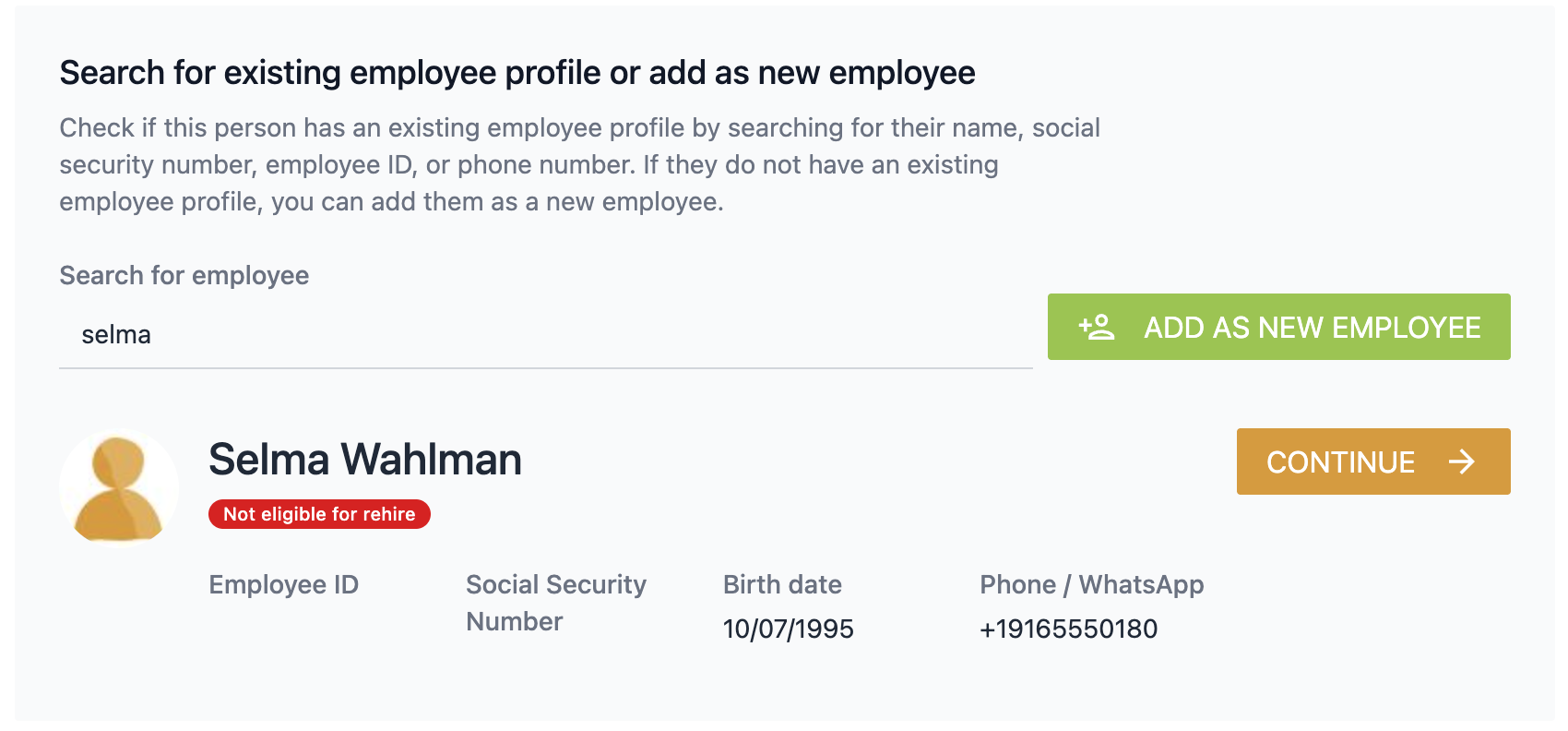
The result is exactly what you want:
- No shadow “do-not-rehire list.”
- No reinventing the story next season
- Faster, cleaner hiring decisions
- A more consistent process that reduces the risk of lawsuits
- Less time dealing with the same problem employee (again) because “we forgot what happened last year.”
For fair, defensible, and frictionless hiring, embrace a system that automatically yields rehire decisions from documented events. If you want to ensure your next crew is made up only of top performers, reach out so we can show you how Harvust can help.